Our experts talk about it : Irricrop, an innovative solution for irrigation
• 3 min read
Irrigation challenges
One of the main consequences of climate change is the increase in temperature and thus increasing evapotranspiration. This leads to increasingly negative water balances in the summer period, due to longer and more intense droughts.
The fact that 20% of cultivated land today is irrigated, or even 80% in some regions irrigation appears to be an essential lever from an environmental, economic and social point of view to meet global food demand
💡
A patented sensorToday, after 4 years of research and development Sencrop innovates, thanks to a patented sensor: the Solarcrop. It characterised by a low temperature dependence and high-quality calibration.
Melissa Comellas, Agronomist, Product Owner Sencrop | Bruno Boissenin, Sencrop Research and Development Manager
A complete solution for irrigation management
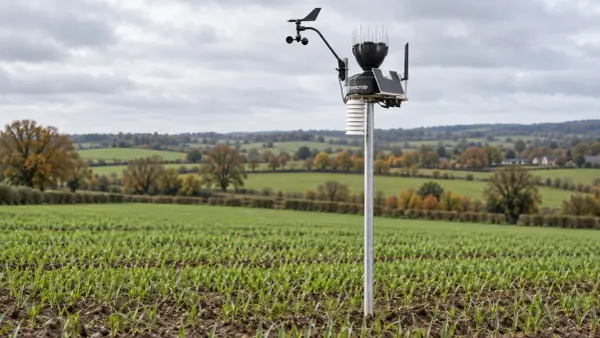
The main climatic factors that influence ETP are: solar radiation, relative humidity, vapour pressure, temperature and wind speed. Sencrop now offers a solution for irrigation control: The Irricrop Pack, consisting of three stations
The second: the Windcrop Anemometer, which measures the wind direction, gusts and average wind speed.
The third and final product: the Pyranometer Solarcrop, which measures solar radiation, and the energy received by your plot.
With this pack, we can calculate evapotranspiration. Soil evaporation and plant transpiration, which allows us to model the water reserve in your soil which is the result of rainfall and irrigation happening on your plots. The evapotranspiration is then subtracted.
These stations also allow you to know the water balance of your soil, i.e. how much is entering the soil and how much is leaving. In the inputs, we count the rainfall (collected by the Raincrop) and the water inputs through irrigation, provided by the farmer. In the output we have the losses by evaporation of water from the soil and transpiration of the plant, which are materialized by the ETP. Once these parameters are known, it is possible to calculate the evolution of the soil water stock accurately.
A simple and innovative solution for irrigation
Today there are already solutions to control irrigation generally these are solutions, which are sensors placed directly in the ground. These can be capacitive or tensiometric sensors. However, these solutions can sometimes be complex to install and costly. At Sencrop we decided to model the water reserve differently, including the measurement of solar radiation.
When installing a probe, it is important to take into account that a certain type of material is needed, firstly the auger to be able to make a hole in which the probe will be positioned, and then all the necessary materials for the extraction and analysis of the soil that was collected. In the Irricrop solution, we only have to install this sensor on the Windcrop mast, and therefore the installation is simplified.
Soil probes require special calibration depending on the location where they are positioned. Unlike the Irricrop Pack, which offers several water balances which can be distributed according to the type of soil or the different plots.
As the aerial part develops throughout the season, the same applies to the roots. In addition, to know the texture, the granulometry, the porosity and even the percentage of organic matter of a soil, is important to know the water storage capacity of the soil. Today in the Sencrop application, there are two ways to set up your ground: One, by manually entering each of the parameters, the other, by choosing from 12 types of soil, such as sandy loam, clay loam... to have pre-set percentages and thus better control irrigation.
A turnkey solution:Water and radiation are the basis of photosynthesis, Sencrop allows you to measure and analyse this data, to better understand the impact of climate change.
More information about the Irricrop Pack and our other solutions on:
Twice a month, news on agricultural weather, ag-tech, and Sencrop innovations to enlighten you and help you make better decisions every day. Subscribe now! 👇