Sencrop reveals its latest generation of weather stations: Customisable, universal and sustainable.
• 3 min read
New Sencrop Generation of agro-weather stations
After many years of research and development and a testing period involving a hundred farmers in several countries, Sencrop, the European leader in connected ag-weather solutions, announces the official launch of its new generation of Sencrop 4G weather stations.
With these new weather stations, Sencrop is opening a new chapter in precision farming. More universal coverage thanks to 4G connectivity, more sustainable thanks to their solar panel, and more efficient thanks to their modularity, these brand new stations embody Sencrop's ambition: to offer all farmers, everywhere in the world, reliable, scalable and accessible tools to better anticipate risks, optimise their field interventions and preserve natural resources.
« This launch is the pinnacle of three years of research and development by our R&D team. With this new 4G technology, we are strengthening our European and global ambitions by offering farmers a universal, accessible and scalable tool. Building on our partnership with ISAGRI, we are leveraging the best technologies to maintain our position as a global technological leader in connected agriculture.»
Martin Ducroquet, Sencrop co-founder and General Manager
Universal connectivity through mobile network access and sustainable energy independence
Sencrop stations are 4G-compatible, opening them up to mobile connectivity. In areas where 4G is not available, data transmission reverts to 2G. And thanks to multi-operator roaming, they can work with local operators in each country, guaranteeing access to the mobile network even in the most remote areas.
The new stations are also equipped with a solar panel connected to a new-generation battery. This extends the battery lifespan to up to 8 years without replacement; solar-powered stations will no longer need to replace the battery.
A new generation of stations : cost-effective, modular and customisable
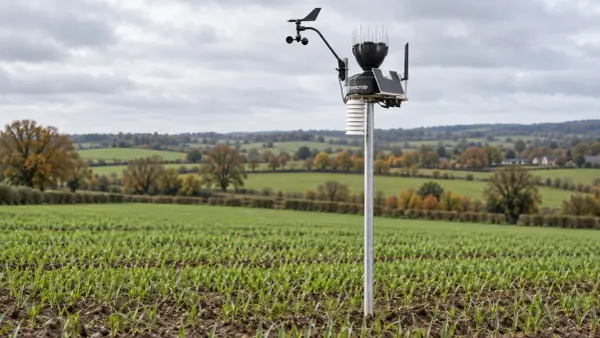
The new generation of 4G stations provides a response to technological developments and growing needs in the field. They are distinguished in particular by their unique modularity: each station can accommodate up to three sensors, which are easily replaceable or interchangeable, to adapt to the specific needs of each crop and territory.
Among the benefits are a significant reduction in production costs and an increase in the station’s lifespan. Thanks to their modular design, farmers no longer need to purchase a complete station each time they want to upgrade, but only the sensors they need. Every component (rain gauge, wind meter, temperature/humidity sensor, solar panel, etc.) is replaceable, for better repairability and extended equipment lifespan. The new generation of 4G stations provides a response to technological developments and growing needs in the field. They are distinguished in particular by their unique modularity: each station can accommodate up to three sensors, which are easily replaceable or interchangeable, to adapt to the specific needs of each crop and territory.
Among the benefits are a significant reduction in production costs and an increase in the station’s lifespan. Thanks to their modular design, farmers no longer need to purchase a complete station each time they want to upgrade, but only the sensors they need. Every component (rain gauge, wind meter, temperature/humidity sensor, solar panel, etc.) is replaceable, for better repairability and extended equipment lifespan.
A comprehensive tool for farmers and an ambition to serve the world
With more than 40 000 stations deployed and 30 000 farmers connected every month in 30 countries, Sencrop aims to use this new technology to consolidate its position as European leader and accelerate its international development.
The mission remains the same: empowering farmers to make better decisions and reduce their crop risks, while leaving a positive environmental footprint.
Sencrop provides:
• ultra-local weather monitoring with data updated every 15 minutes,
• customisable frost and treatment alerts,
• agronomic tools to identify risks at the field level,
• advanced solutions for irrigation and water stress management.
• remote station maintenance and monitoring, thanks to a dedicated team of data scientists.
About Sencrop
Sencrop, ISAGRI's new subsidiary within the ISAGRI Group, brings recognised expertise in connected agro-meteorology. This expertise is based on three pillars: collaborative weather forecasting, incorporating local and regional weather observations and forecasts; agronomic risks monitoring (plant cycles, diseases, pests, etc.) and climatic risks; water management and irrigation control. With more than 40,000 active weather stations and a community of 30,000 farmers and 600 user groups in 30 countries, Sencrop is now the leading platform for agro-meteorological data and risk management in Europe: it enjoys a strong brand, synonymous with collaborative weather forecasting, daily use; a platform open to players in the ecosystem (towards DSTs, FMIS, plot management tools, etc.) and an offering accessible to all, with a shared DNA of serving farmers and listening to their needs, so that they can make their own decisions independently.
The Sencrop team
Share this article
A newsletter on weather and Ag-Tech
Twice a month, news on agricultural weather, ag-tech, and Sencrop innovations to enlighten you and help you make better decisions every day. Subscribe now! 👇